

 Sign in


How to protect yourself from the cold while skiing: Our tips for staying warm
Skiing in the heart of winter can be a magical experience… but also an uncomfortable one if you are not properly equipped. Between wind, snow, altitude and moisture, conditions can quickly become challenging.
Many skiers therefore wonder how not to feel cold while skiing. Understanding what influences the feeling of cold and adopting the right habits makes it possible to fully enjoy the slopes and stay warm while skiing when temperatures drop.
What factors increase the feeling of cold?
The sensation of cold in the mountains depends on a combination of several factors. Wind is one of the most significant: it accelerates heat loss, known as the wind chill effect. A temperature of -5°C can actually feel like -15°C when gusts blow along the ridges. Moisture also plays a crucial role. When clothing retains perspiration or when snow melts against the skin, cooling is intensified.
Altitude also contributes to this sensation. The higher you go, the drier the air and the lower the temperatures. Finally, inactivity between runs or time spent on chairlifts exposes the body to the cold for extended periods. This is why skiing in very cold weather can become difficult without applying a few essential rules.
How to dress for skiing: the role of the 3-layer system
To avoid feeling cold while skiing, it is essential to understand what is truly expected from ski clothing. Ski garments must not only protect against cold and wind, but also wick away perspiration and provide enough comfort to allow full freedom of movement.
The most effective method for dressing in the mountains remains the three-layer system:
- The first layer, next to the skin, must wick away moisture: technical fabrics or merino wool are ideal, as they dry quickly and limit the cold sensation caused by perspiration.
- The second layer provides thermal insulation: a fleece, lightweight down jacket or technical sweater helps retain body heat.
- The third layer protects against the elements: the ski jacket must be waterproof, windproof and breathable. Its role is to block wind, prevent water from penetrating and allow water vapor to escape, avoiding the “steam room” effect.
Ski pants follow the same logic: a thermal base layer combined with a waterproof outer layer ensures good insulation. Waterproofness is measured using ratings (for example 10,000 mm or 20,000 mm). The higher the value, the more resistant the garment is to snow and moisture.
It is also essential to choose clothing in the correct size. A ski outfit should be loose enough to ensure freedom of movement and allow warm air to circulate.
However, it should not be too loose, as this would allow cold air to enter. Clothing that is too tight restricts blood circulation and increases the feeling of cold while skiing. Not to mention that overly tight clothing also tends to limit freedom of movement.
Focus on feet: how to keep them warm
Feet are often the first to suffer from the cold while skiing. Enclosed in rigid boots and less well supplied with blood than the rest of the body, they cool down quickly if the socks are not suitable. To truly avoid feeling cold while skiing, choosing the right sock is almost as important as choosing the boot.
Choosing the right material for ski socks
A thick sock is not necessarily a good ski sock. In reality, a high-quality sock that effectively protects against the cold often contains the following materials:
- Wool, particularly merino wool, provides warmth and thermal regulation. It keeps feet warm while limiting odors and absorbing moisture.
- Synthetic fibers such as polyester or polyamide quickly wick away perspiration and reinforce sensitive areas (heel, shin, toes, etc.).
- Elastane allows the sock to conform to the shape of the foot and stay securely in place.
By contrast, basic socks are often made of cotton or acrylic. These materials breathe poorly, trap moisture without releasing it, and fail to retain warmth.
The use of premium materials such as carefully selected merino wool partly explains a price range of €20 to €25 per pair: this is no longer a simple sock, but equipment designed to withstand cold, moisture and time.
Precise sizing for real comfort
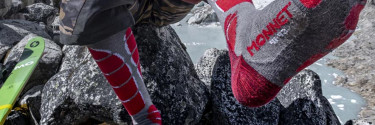
Sizing is another key point that is often underestimated. The more precise the size, the better the sock adapts to the foot. Technical manufacturers like Monnet offer sizes in close increments (39–40, 41–42, etc.), which limits folds, friction and pressure points.
Conversely, broad size ranges such as 40–44 or 35–38 inevitably involve compromise: on some feet the sock will be loose, on others too tight. A sock that is too large creates folds and increases the risk of blisters; a sock that is too small compresses the foot, restricts blood flow and accentuates the feeling of cold. Precise sizing is therefore a true comfort criterion… and a marker of quality.
Design, support and compression
Beyond material and size, design makes all the difference. A so-called “hemispherical” heel, knitted in a Y-shape, follows the natural shape of the human heel and prevents the sock from slipping under the sole of the foot. Models with differentiated left and right feet fit the anatomy even better and limit folds inside the boot.
Technical socks also eliminate thick seams at the toes, which are particularly uncomfortable in tight ski boots. Modern knitting techniques make it possible to achieve an almost seamless toe, reducing friction and pain at the front of the foot.
Finally, support and compression play an important role. The presence of elastane and targeted support zones (arch, ankle, calf) helps keep the sock in place, provides light muscle support and improves venous return. Compression remains gentle, but contributes to comfort, a sense of precision inside the boot and reduced fatigue at the end of the day.
Boots, thickness and heated insoles
Even the best sock in the world will only be effective if the boot is properly fitted. There should always be enough room for the toes to move slightly. If the boot is already very tight, a sock that is too thick will compress the foot, restrict circulation and paradoxically make it feel colder. A thin but highly technical sock is better than a bulky model that does not match the boot’s volume.
Heated insoles can be a solution for people who are very sensitive to cold, provided power and bulk are well managed. If they take up too much space or cause excessive sweating, the foot will cool down as soon as the heat stops. Once again, balance between boot volume, sock thickness and any additional heat source is essential.
In summary, keeping feet warm while skiing does not depend on a single “thick” sock, but on a combination of technical details: high-performance materials, precise sizing, anatomical heel, differentiated left/right foot, seamless toe, controlled support and compression, etc. This technical expertise justifies the price of a good ski sock and, above all, makes the difference over a full day in the mountains.
Focus on hands: fighting heat loss
Hands are particularly sensitive to the cold because blood circulation naturally decreases to preserve core body temperature. To avoid feeling cold while skiing, it is essential to use suitable gloves.
Gloves with a waterproof and breathable membrane are the most effective in harsh conditions. Some skiers prefer mittens, which help retain heat more easily thanks to fingers being grouped together.
It is also possible to add a thin silk or wool liner to increase insulation. This layering system, applied to the hands as well as the rest of the body, significantly improves comfort.
Other essential equipment for staying warm
Several accessories help improve thermal comfort. A helmet with a fleece lining retains heat around the head, while also protecting against impacts.
A balaclava or neck warmer protects the neck and lower face, which are particularly exposed to the wind.
Finally, ski goggles protect against wind, reduce heat loss through the eyes and shield against UV rays, which are very strong at altitude.
These elements are not secondary: they effectively complete a well-thought-out outfit and are among the best tips for not feeling cold while skiing.
Bonus: small habits that make a big difference
Beyond clothing, small habits help manage the cold more effectively. Eating a calorie-rich meal before hitting the slopes provides the body with the energy it needs to produce heat. Bringing a hot drink also helps maintain body temperature.
It is also advisable to take regular indoor breaks, especially on windy days or after prolonged exposure to the cold. These moments allow the body to recover before heading back out.

At what temperature should you give up skiing?
There is no strict rule, but certain thresholds should raise concern. Below -20°C, especially when accompanied by strong winds, the risk of frostbite increases significantly. For children, seniors or people who are sensitive to the cold, skiing in extreme cold can be dangerous.
When in doubt, it is better to postpone the outing or shorten the session. No skiing pleasure is worth the risk of hypothermia or injury caused by loss of sensation in the extremities. Beyond the temperature shown on the thermometer, what matters most is how you feel: listen to your body. Weakness, shivering and numbness are all warning signs.
In short, knowing how to stay warm while skiing relies on several factors: understanding how cold affects the body, choosing suitable clothing, protecting sensitive areas and adopting good habits throughout the day.
With a well-designed outfit, suitable socks, quality equipment and a few simple habits, it is entirely possible to stop feeling cold while skiing, even when temperatures drop. Preparation, comfort and safety are the keys to fully enjoying the pleasures of the mountains, whatever the outside temperature.
Related products


Related posts
If you’re wondering what outfit you need for cross-country skiing, keep one simple idea in mind:...
When wondering what outfit to choose for ski touring, keep one key point in mind: ski touring is...
When you’re getting ready for a trip to the mountains, you often think about the suit, the color...

After a day on the slopes, it’s time for the second highlight of the holiday: après-ski. Between...

Even before talking about technique or skill level, one question always comes up before a trip to...

Preparing a mountain holiday with children always raises the same question: how should you dress...

Why Do We Feel Cold Feet? When skiing, it's often because it's actually cold! Each person has...
Although it is a common and benign injury, foot blisters are the bane of skiers. What are the...
As we indicated in a previous article, **nearly 90% of skiers experience pain in their ski...

You have just started your stay at the resort, and you joyfully ski down your first slopes. But...