

 Sign in


What Socks Should You Wear with Derby Shoes?
Some shoes immediately impose themselves, while others require a little more precision to reveal their full potential. Derby shoes probably belong to the second category.
Elegant without being stiff, more flexible than a pair of Oxfords, derby shoes can easily move from a formal wardrobe to a more relaxed silhouette. But while they are now among the most versatile everyday shoe styles, you still need to know how to wear them properly!
Visible or discreet, thin or thick, a simple accessory or a fully assumed element of your outfit, socks can extend the elegance of a pair of derby shoes… or completely break its coherence. So asking yourself which socks you should wear with your derby shoes is less a detail than a true style choice.
A little history: where do derby shoes come from?
The derby shoe is above all recognized by its open lacing. In practical terms, the quarters are sewn on top of the vamp, unlike the Oxford, which has closed lacing. This is what gives it a slightly more relaxed look, an often more accessible fit, and a certain stylistic versatility.
Historically, the derby first became popular as a more “sporting” shoe or ankle boot in the 19th century, before finding its full place in the urban wardrobe at the turn of the 20th century. The construction of derby shoes, both more comfortable and less strict than Oxfords, explains why they move so easily between different uses and silhouettes.
And it is precisely this flexibility that makes the choice of socks so important. Derby shoes are not worn quite like formal shoes. In truth, they call for more nuance, and more freedom.
Should derby shoes be worn with or without socks?
In theory, the idea of wearing derby shoes without socks can be appealing. But in practice, it is far better to wear them with socks. First, for an obvious reason: comfort. Secondly, because socks absorb perspiration, reduce friction, and protect both the foot and the inside of the shoe.
Even though derby leather is now relatively supple, after a day at the office or a long walk in the city, a pair of socks remains essential.
That does not mean you have to give up the famous “bare ankle” effect. In fact, this effect often relies on an illusion. You never really go out barefoot: instead, you opt for invisible socks or very low ankle socks. At Monnet, the lifestyle range includes invisible, classic, and high models, in materials designed for different seasons, such as linen/cotton for summer or cashmere for the colder months.

What sock height should you choose with derby shoes?
The height of the sock immediately changes the look of a pair of derby shoes. An invisible sock does not say the same thing as a classic sock, and even less so than a fully assumed high sock.
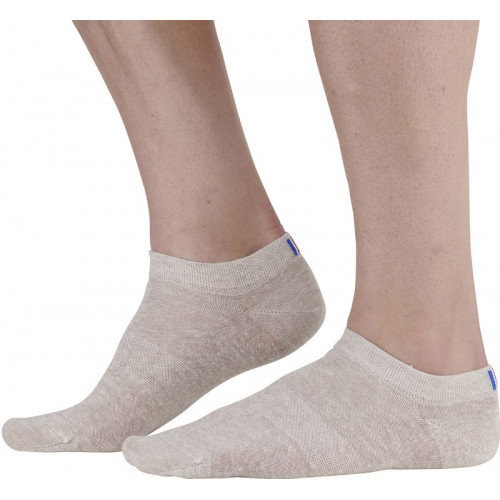
Invisible socks remain the simplest choice when you want a lightweight look. They work particularly well with summer derby shoes, cropped trousers, or when the ankles are meant to remain visible. Monnet invisible linen/cotton socks were clearly designed with this in mind and are especially pleasant to wear in hot weather.
Classic or mid-calf socks, meanwhile, are the easiest to integrate into everyday outfits. They naturally go with raw denim jeans, chinos, wider trousers, or a smart casual silhouette. They allow you to introduce color or texture in a measured way, without overpowering the rest of the outfit.
As for high socks, they play on two very distinct registers. On the one hand, they elegantly extend a formal outfit, especially with a suit, as they prevent a section of leg from showing when seated. On the other, they can reinforce the intended style when they are visible and fully embraced. This is precisely the strength of derby shoes: they lend themselves just as well to discretion as to a more assertive expression.
Which materials should you choose with derby shoes?
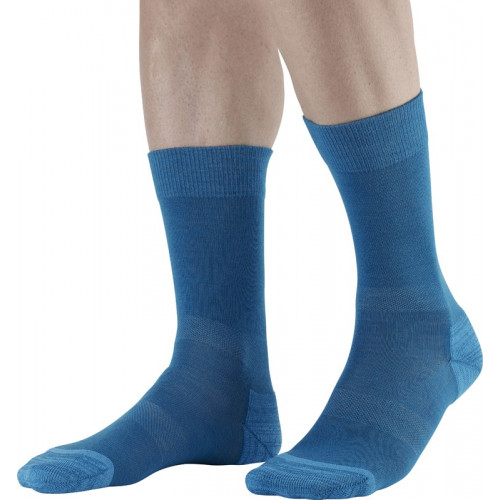
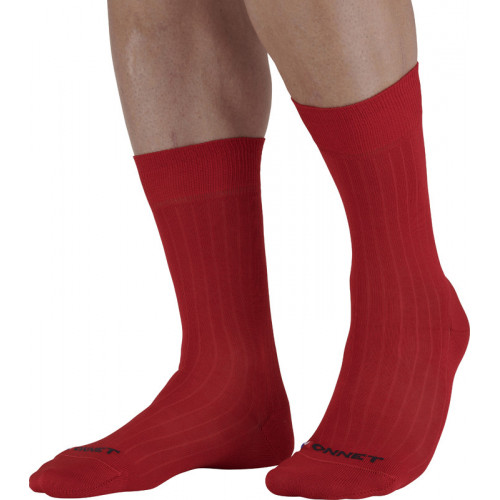
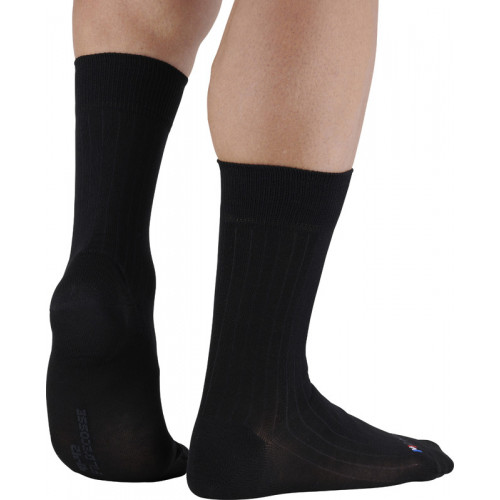
With dress derby shoes, lisle thread is an obvious choice. At Monnet, it holds a special place in the lifestyle range: finer, sharper visually, and more refined in appearance, it perfectly complements a formal or business wardrobe. It is the most natural option if you are looking for an elegant sock that can extend a polished silhouette without ever overdoing it.
For everyday wear, organic cotton is a very safe base. Softer and pleasant to wear, it fits naturally into a smart casual or urban wardrobe. Monnet uses it in understated lifestyle models, with heel and toe reinforcements, as well as a seamless toe area, adding real everyday comfort.
In warm weather, linen/cotton becomes particularly interesting. At Monnet, this blend stands out for its freshness and lightness, making it a coherent choice to pair with more summery derby shoes, in supple leather or light suede.
In autumn and winter, finally, merino wool or cashmere models naturally find their place with more substantial derby shoes, flannel trousers, fine knits, or a long coat. You gain warmth, but also visual depth, which suits the season particularly well. Monnet offers lifestyle models in these materials, in medium or high lengths.
Why does sizing change everything?
People often talk about color, material, or height. Yet sizing deserves just as much attention. A poorly fitted sock always ends up betraying the outfit: it slips, forms folds, feels too tight, or loses its neatness.
This is especially true with wide size ranges. A sock labeled 42-45, for example, cannot possibly fit every foot it claims to cover perfectly. If you are a size 42, it may feel too loose; if you are a size 45, it may become too stretched. In both cases, comfort suffers, but so does the look.
In its lifestyle ranges, Monnet specifically favors more precise sizing, often offered in two-size increments. This may seem like a small detail, but in reality it changes a great deal: support, stability inside the shoe, the finesse of the fit, the absence of folds, and more. With derby shoes, where the line is sharper than with sneakers, this is immediately visible.
How should women wear derby shoes with socks?
When thinking about how to wear derby shoes with socks for women, several options are available. It all depends, in reality, on the look you are aiming for.
In a minimalist register, a pair of black or chocolate derby shoes, straight raw denim jeans, a white shirt, and a light blazer call for discreet, fine, understated socks. A classic height in organic cotton or lisle thread is more than enough to preserve the elegance of the whole outfit.

In a more fashion-forward silhouette, the sock can become more visual. A sweater dress, a midi skirt, a belted coat, and a pair of patent derby shoes can work very well with a mid-calf or high sock, provided it fits harmoniously within the outfit’s color palette. Here, the sock no longer plays a purely practical role: it fully contributes to the balance of the silhouette.
In warm weather, finally, lighter derby shoes, cropped trousers, or a shirt dress can work very well with invisible socks or very low socks, especially if you are looking for a more airy result.
What socks should men wear with derby shoes?
For men, knowing which socks are best to wear with derby shoes is mainly about the relationship between the shoe, the trousers, and the overall style register.
In a business setting, a fine, high or mid-calf sock, sober, well-cut, and made from an elegant material remains the safest option. With a blue suit and brown derby shoes, for example, navy or deep burgundy lisle thread works very well. With grey trousers and black derby shoes, charcoal grey and black remain excellent choices.
In a smart casual register, sand-colored chinos, a fine knit, and dark brown derby shoes pair very well with organic cotton socks, in navy, medium grey, or brown tones.
And if you move toward a more relaxed style — raw denim, a casual jacket, suede derby shoes — invisible socks or lighter models become entirely relevant, especially in spring.
How should you match sock colors with derby shoes?
The safest rule is generally to keep the sock close to the color of the trousers. This visually lengthens the leg and immediately creates a sense of coherence. This is especially true in a formal context.

With brown derby shoes, navy, grey, burgundy, reddish brown, or dark green socks are particularly interesting. With black derby shoes, black, charcoal grey, or very dark blues are usually preferred. With summery or lighter derby shoes, ecru, soft beige, and pearl grey bring more flexibility.
In other words, the most important thing is to create harmony between the socks and the derby shoes. The sock should find its place within the outfit, either by extending the leg or by echoing another element of the look.
Wearing socks with derby shoes: what to remember
Wearing derby shoes with socks is not a constraint. On the contrary, it is often what allows the silhouette to gain in comfort, coherence, and elegance. The right choice depends on several factors: height, dominant material, season, sizing, and of course, the desired look.
With dress derby shoes, lisle thread remains an obvious choice. For everyday wear, organic cotton is a safe bet. In warm weather, linen/cotton takes over. And when temperatures drop, merino wool or cashmere bring depth back into the outfit. In short, the right sock is not just the one that “goes with” the shoe: it is the one that naturally finds its place within the whole outfit.
Related products


Related posts

In sport, we readily talk about training, nutrition, hydration, stretching or equipment. Sleep,...

Photo: Trail des Cimes After a workout, we often think about the performance we delivered, the...

When temperatures drop, natural materials naturally come back into the spotlight. Sweaters,...

Cashmere is one of those materials spontaneously associated with softness, warmth, and a certain...

When it comes to trail running, there is a lot of talk about preparation, effort management,...

There was a time when high socks were associated with military uniforms, school wardrobes, or...

When a garment causes itching, redness, or a feeling of discomfort, we often tend to immediately...

Long appreciated for their practical side, socks have now become an essential accessory in any...

If you’re wondering what outfit you need for cross-country skiing, keep one simple idea in mind:...

When wondering what outfit to choose for ski touring, keep one key point in mind: ski touring is...