

 Sign in


Bad foot odor, how to get rid of it?
Removing your shoes when arriving at a friend's house may seem completely harmless. Except... when you have smelly feet!
Where do these bad odors come from? How can you prevent and eliminate them? That's what we'll see in this article.
What is the origin of the bad odor of feet?
It's due to sweating: the foot is the part of the body that contains the highest number of sweat glands: about 600 glands per square centimeter, compared to 200 in the rest of the body.
The sweat glands produce sweat that allows the body to cool down when it gets hot, thanks to the contact between the body's moisture and the air.
Sweat is a mixture of water and salt, therefore odorless when secreted.
Most often wrapped in socks and shoes, the feet do not come into contact with the air, and this sweat doesn't dry quickly.
The maceration that results allows bacteria, fond of this type of humid and warm environment, to develop in large numbers. These bacteria feed on dead skin cells and secrete residual substances containing organic acids. It is these acids that are responsible for the bad odors, also known as "bromodosis" when they concern the feet.
How to know why my feet stink?
Before looking for a solution to eliminate the bad odors of the feet, it is important to identify the exact cause.
Indeed, the origins can be varied:
- Some people are more predisposed: genetic or hereditary factors, diseases, hormonal fluctuations especially in women...
- Other factors, such as dermatological conditions, or habits and behaviors, exacerbate this phenomenon.
First, you must know in which category you belong.
How to reduce the bad odor of my feet?
Here are the solutions and tips we know to eliminate the bad odor of the feet, according to each profile:
Dermatological conditions:
Here are two common dermatological conditions: how to diagnose them and how to treat them:
- Athlete's Foot: redness, itching, burning, split nails, and changes in color are signs of the presence of fungi responsible for athlete's foot. You can apply an antifungal cream on your feet, available over the counter at the pharmacy. But if the symptoms persist, it is advisable to consult a doctor.
- Pitted Keratolysis: white, wet, perforated skin with small holes on the sole of the foot. These are the symptoms of pitted keratolysis, which causes a very strong and pronounced odor. The presence of this bacteria requires a consultation to determine if the administration of an antibiotic is necessary.
Habits and behaviors:
If your behavior is responsible for the bad odors, that's good news: it's something you can easily change. Here's how:
- Intensive sports practice inevitably leads to abundant sweating and the related inconveniences. Be sure to wash your feet thoroughly after each session, change your socks regularly, and properly air out your shoes.
- Poor foot hygiene also provides a favorable environment for the appearance of bad odors. So make an effort in that regard!
Genetic predispositions:
If you are one of the people with a "natural predisposition" to smelly feet, it will be more difficult to act on the cause.
No need to panic, you are not without a solution. Here we offer you a detailed response to eliminate foot odors in the case of a "genetic predisposition":
- Make sure to have impeccable hygiene
- Daily washing with a mild soap, and thorough drying, taking great care of the spaces between your toes.
- Regular removal of dead skin and calluses, at least once a week, using a scrub, pumice stone, or an electric file.
- Regularly moisturize your skin to reduce the production of dead skin and calluses.
- Regular nail trimming
- Change socks daily, and more if needed.
- Pamper your feet
- Foot baths: they enhance the hygienic care of your feet! Plus, they relieve tired feet by promoting blood circulation. By adding a few drops of Tea Tree essential oil at the end of your foot bath (for a few minutes only), you strengthen the fight against bacterial proliferation.
- Air!: Let your feet breathe as often as possible. However, be careful not to walk barefoot anywhere to avoid increasing bacteria on your feet.
- Deodorizing powders and talcs: they absorb moisture, limiting the growth of bacteria and the associated odors, while providing a light fragrance. Apply in the morning and evening on clean, dry feet.
- Deodorants and antiperspirants: in gel, cream, or spray form, containing aluminum chloride, antiperspirant, or antibacterial properties, they help reduce sweating and control odors. It's best to use them as a spray for easy and quick application throughout the day. They are usually available over the counter at pharmacies, so feel free to ask your pharmacist for advice!
Properly Equipping Your Feet
As mentioned earlier, if our feet are prone to bad odor, it's because they spend most of their time enclosed. Therefore, make sure to choose and use the right equipment for them.
Shoes:
Don't always wear the same shoes to allow them to dry. Ensure they are not too tight to provide some space and air circulation. Wear quality shoes made of breathable materials.
Some brands, well aware of this issue, have made it their trademark! Regularly check the insoles, which over time may not live up to their name and contribute to odor problems.
Do not hesitate to replace them, maybe with insoles having absorbent and anti-odor properties.
Socks:
As the primary item in contact with your foot and the only interface with the shoe, socks are the FIRST item that requires your full attention.
- First thing to do: always wear them with closed shoes to absorb sweat and prevent moisture buildup.
- Secondly, change them at least once a day.
- Lastly, choose the right material to combat moisture and bacterial growth. But there is so much important information on this topic that we dedicate a whole paragraph to it right below.
Opt for socks made of breathable materials: the most effective fibers in this regard are natural fibers. They have antibacterial properties, which help reduce odors.
Wool:
Whether it comes from sheep, goats, or alpacas, this natural fiber is hydrophilic and has a high capacity to absorb and wick away moisture, while drying quickly. This keeps you dry!
Wool has an antibacterial effect due to its absorption power and fiber structure, limiting unpleasant odors.
Among all types of wool, Merino wool stands out from the others in sock design due to the fineness of its fibers, making it much softer and lighter. Cashmere, wool from a goat, also brings more lightness and softness to your feet, but it is more expensive and requires more maintenance.Silk:
Derived from an insect larva, silk is another natural fiber with incredible properties. Silk socks offer good thermoregulatory capacities and can be worn perfectly in both summer and winter.
The delicacy and softness of silk will ideally complement your elegant outfits for special occasions, or feminine outfits.
Linen:
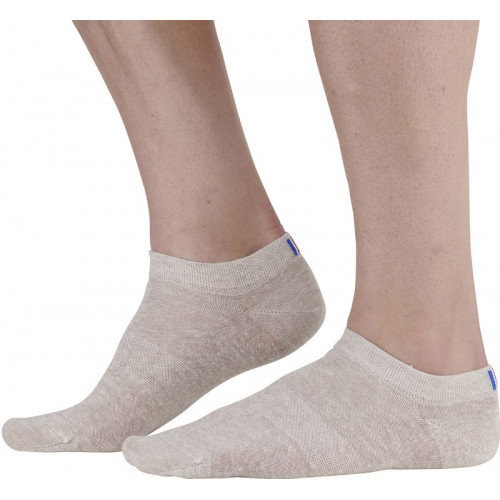
Linen, particularly appreciated for summer clothing, will delight your feet by providing freshness and ventilation. The more you wear them, the softer they become!
Viscose, Bamboo...
These two materials are both derived from the synthesis of a natural material: cellulose, the main constituent of plant cell walls. They provide lightness and breathability to the fabric. Their moisture absorption capacities are much higher than that of cotton. They are also naturally antibacterial and thermoregulatory, regardless of the weather conditions.
Sock Materials to Avoid to Prevent Foot Odor
Avoid cotton at all costs!
It is the most commonly used material in sock manufacturing because once woven, its fibers are very resistant and comfortable.
However, despite being a natural fiber, it is not suitable if you want to avoid foot odor! Indeed, cotton absorbs moisture and becomes waterlogged, promoting maceration.
Avoid socks made with synthetic materials.
Polyester, polyamide, or nylon do not wick away moisture and do not offer the thermoregulatory qualities of natural materials. They tend to promote bad odors.
How to Remove Bad Odors from My Shoes?
The damage is done and your shoes retain traces, or rather lingering smells... Don't panic, there are solutions to make them disappear.
- Sunlight: The first step is to dry your shoes in the sun. Sunlight acts as a natural disinfectant by killing potentially present bacteria.
- Cold: Cold is also a good ally as it kills bacteria. Place your shoes in a plastic bag, then in a freezer, or outside when it is very cold, overnight.
- Essential oils: Tea tree, clove, and cedarwood essential oils have deodorizing and antifungal properties. Put a few drops in your shoes and let them air dry.
- Baking soda: It absorbs moisture and bad odors while also preventing the proliferation of bacteria. Sprinkle baking soda in your shoes and let it sit for 24 hours before vacuuming it out.
- Vinegar: Vinegar neutralizes odors and fights bacteria. Mix equal parts white vinegar and water and spray the solution inside the shoes, then let them dry.
- Talcum powder: Just like when you sprinkle it on your feet, talcum powder absorbs moisture and slows down bacterial growth. Sprinkle the inside of your shoes before wearing them.
- Deodorants: There are deodorants in spray form to be sprayed inside shoes. However, the composition of these products is not always natural, they can be more expensive, and it's not always clear if they eliminate odors or just mask them.
You now have all the information to take care of your feet and their odor!
Related products




Related posts
In sport, we readily talk about training, nutrition, hydration, stretching or equipment. Sleep,...

Photo: Trail des Cimes After a workout, we often think about the performance we delivered, the...

When temperatures drop, natural materials naturally come back into the spotlight. Sweaters,...

Cashmere is one of those materials spontaneously associated with softness, warmth, and a certain...

When it comes to trail running, there is a lot of talk about preparation, effort management,...
There was a time when high socks were associated with military uniforms, school wardrobes, or...
Some shoes immediately impose themselves, while others require a little more precision to reveal...
When a garment causes itching, redness, or a feeling of discomfort, we often tend to immediately...
Long appreciated for their practical side, socks have now become an essential accessory in any...

If you’re wondering what outfit you need for cross-country skiing, keep one simple idea in mind:...