

 Sign in


Which socks should I choose to stop my feet from sweating?
Many French people sweat from their feet... It's not a big deal. This natural phenomenon, essential for our body, can however become problematic in certain situations.
In this article, we will discover why we sweat from our feet, and how simple socks can play an important role in reducing sweating.
Why do we sweat from our feet?
Sweating is a physiological phenomenon that allows our body to maintain a constant temperature: when sweat evaporates through the skin pores, heat is released, and the skin and body temperature decreases. Sweat is secreted by sweat glands, which are present in the deep layer of the skin. The body has two to four million of these glands. Feet are one of the body parts where the highest number of these glands are found, along with the armpits, hands, face, and groin.
Sometimes, this sweating can be excessive, especially on the feet. This is referred to as plantar hyperhidrosis or excessive foot sweating. It can be simply hereditary, caused by intense physical activity, but also by overweight, stress, or hormonal imbalance.
Can socks play a role in reducing sweating?
Yes! The textiles used in making socks all have various properties: thermoregulation, moisture absorption, support... each material has its advantages and disadvantages, but there is definitely one that will help you sweat less!
What are the best sock materials to reduce foot sweating?
Natural materials have very interesting characteristics for reducing foot sweating.
- Wool: Whether from sheep, goats, or alpacas, this natural fiber is hydrophilic and has a high capacity for moisture absorption and evaporation, while drying quickly. This keeps you dry! Its thermoregulatory properties will keep your feet at the right temperature regardless of the season. Wool socks can also be worn in summer, as it is insulating in both cold and hot weather, and thermoregulating. Wool also has an antibacterial effect, thanks to the structure of its fiber, which helps to reduce odors.
- Bamboo: Bamboo fiber is synthesized from bamboo cellulose. Used in making socks, it provides lightness and breathability to the fabric. Its moisture absorption capabilities are much higher than cotton. It is also naturally antibacterial and thermoregulatory, in all weather conditions.
- Lin: Linen is a natural, antibacterial, and thermoregulatory material. Linen is very hydrophilic, meaning it absorbs water quickly while remaining dry to the touch. Socks containing linen are therefore more comfortable to wear in summer, which is when we sweat the most during the year.
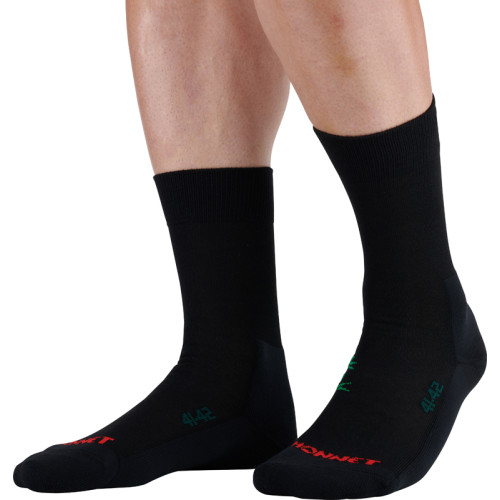
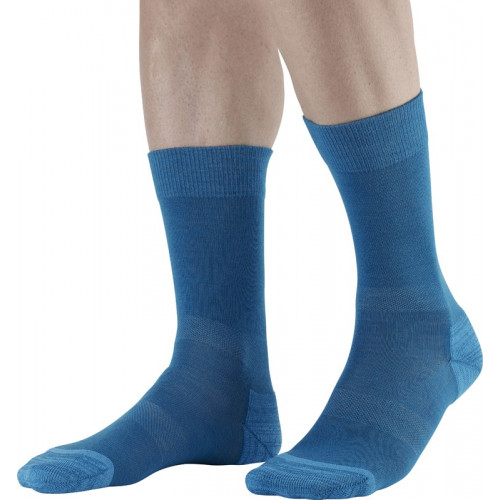
At the bottom of this article, you will find three models of socks made of wool, bamboo, and linen. Note that these models are available in different heights: invisible, low, medium, and high for some.
Which sock materials to avoid?
Synthetic materials such as polyester, polyamide, or nylon should be avoided, especially when used in large quantities in making socks. Although they are durable and more elastic, they do not wick away moisture and do not offer the thermoregulatory qualities of natural materials. However, synthetic fibers are often combined with natural fibers in sock composition: they are found in varying percentages depending on the models.
So, your choice should be oriented towards socks whose main material is natural and offers the best chances of reducing sweating!
Related products



Related posts
In sport, we readily talk about training, nutrition, hydration, stretching or equipment. Sleep,...

Photo: Trail des Cimes After a workout, we often think about the performance we delivered, the...

When temperatures drop, natural materials naturally come back into the spotlight. Sweaters,...
Cashmere is one of those materials spontaneously associated with softness, warmth, and a certain...

When it comes to trail running, there is a lot of talk about preparation, effort management,...
There was a time when high socks were associated with military uniforms, school wardrobes, or...

Some shoes immediately impose themselves, while others require a little more precision to reveal...

When a garment causes itching, redness, or a feeling of discomfort, we often tend to immediately...
Long appreciated for their practical side, socks have now become an essential accessory in any...

If you’re wondering what outfit you need for cross-country skiing, keep one simple idea in mind:...