

 Sign in

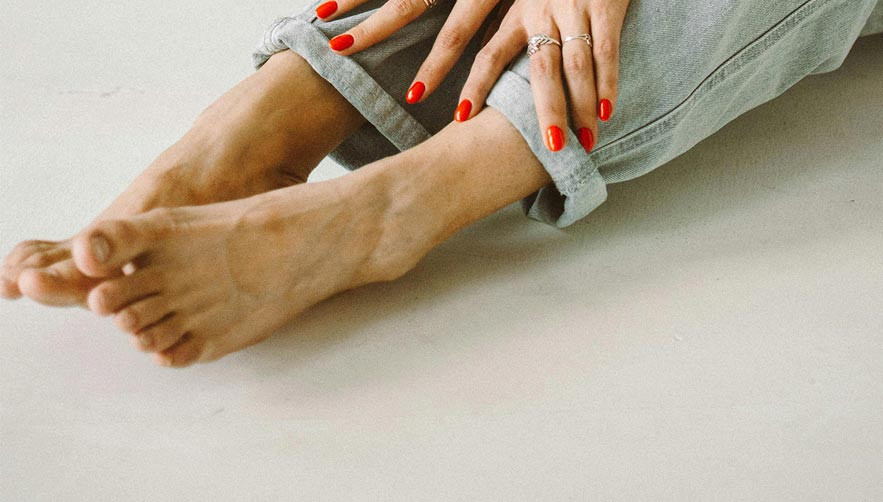
Nail trauma, what to do?
A corner of the sofa, a long trail descent, ski boots that are a bit too tight… The toenail takes a lot of knocks before it turns black, yellow or starts to lift. Here is how to recognise a nail trauma, treat it, and above all prevent it.
The problem
- A knock or repeated rubbing against the shoe damages the nail: haematoma (black nail), lifting, a yellow or thickened nail.
- Athletes (trail running, running, hiking, skiing) are the most exposed.
The stakes
- A toenail takes 12 to 18 months to fully grow back.
- If poorly treated, a trauma can become infected or leave a misshapen nail. And not every dark mark is a haematoma.
The solutions
- The right actions straight after the knock, and knowing when to drain the nail… or see a doctor.
- Well-trimmed nails, shoes in the right size, and socks that protect the tip of the foot.
Are your toes often battered by friction? Discover our anti-blister hiking socks, designed with a double layer to absorb friction instead of your foot.
What is the nail for?
The nail protects the tip of the toe from knocks and pressure. It is made up of three parts:
- the nail plate: the hard, visible part, made of keratin;
- the nail bed: the highly vascularised skin on which the plate rests;
- the matrix: the "root" hidden under the skin, at the base of the nail, which produces it continuously.
This is why a knock quickly causes bleeding under the nail: the nail bed is supplied by many small vessels. And if the matrix is affected, the nail may grow back ridged, wavy or thickened.
What are the nail traumas?
There are two families: accidental traumas, caused by a single impact, and micro-traumas, caused by repeated knocks or friction.
Accidental traumas
These follow an impact or a crush: a toe banged against a piece of furniture, a heavy object dropped on the foot… Blood builds up between the nail plate and the nail bed: this is the subungual haematoma, better known as a black nail (or blue nail at first). It can spread across the whole nail surface if the bleeding is heavy.
More rarely, the impact partly tears the nail off, causes a wound, or fractures the last bone of the toe.
Micro-traumas
These result from small repeated knocks or friction: the toe hitting the front of the shoe with every step, or the nail rubbing against the shoe or a seam. They can cause:
- successive small haematomas, which eventually blacken the nail: the "runner's black nail";
- a nail that thickens, yellows or lifts away from its bed (onycholysis);
- an ingrown nail or retronychia (see below).
A damaged nail can also become an entry point for fungi, especially in a damp shoe.
| Type | Cause | Signs | Example |
|---|---|---|---|
| Accidental trauma | Single impact, crush | Sharp pain, nail red then blue or black | Toe banged against a bed frame |
| Micro-trauma | Repeated knocks or friction | Nail gradually blackened, yellow, thickened or lifted | Big toenail blackened after a marathon |
Why are athletes exposed?
On a trail or a hike, the toe can hit the front of the shoe thousands of times. Several factors make these micro-impacts worse:
- descents: the foot slides forward and the toes bear the body's weight;
- shoes that are too tight, or too big and poorly laced: the foot swells during exercise, and a loose foot moves with every step;
- nails that are too long, which hit the front of the shoe first;
- unsuitable socks: too thick, too small, or that slip and form folds under the toes;
- sweating, which softens the skin and encourages fungal infections.
Each activity has its own risk situations:
- trail and running: the big toe often blackens after a long or very downhill run (see our tips for avoiding blisters when running and trail running);
- hiking: long descents in stiff boots put strain on the nails (see how to avoid toe and nail pain when hiking);
- skiing: the stiff boot exerts constant pressure on the front of the foot (see what to do about foot pain in ski boots).
Black nail: is it serious?
In the vast majority of cases, a black nail is a simple haematoma, with no serious consequences. However, a dark discolouration can also indicate a fungal infection or, much more rarely, a subungual melanoma (a skin cancer under the nail).
The simplest guide: a haematoma moves up with the nail as it grows, whereas a mark caused by melanoma stays in place or widens.
| Haematoma | Fungal infection (onychomycosis) | Subungual melanoma (rare) | |
|---|---|---|---|
| Cause | Single or repeated knocks | Fungus | Proliferation of pigment cells |
| Appearance | Red mark, then blue, then black | Yellow, brown or blackish nail, thickened, crumbly | Brown or black band running lengthwise, sometimes spreading onto the skin |
| Progression | Moves up with growth and disappears | Spreads slowly, does not heal on its own | Stays fixed or widens |
| What to do? | Monitor, drain if painful | Antifungal treatment, medical advice | See a dermatologist promptly |
A dark mark that appears without any knock should always be checked by a doctor.
What to do right after the knock?
The first few minutes limit the size of the haematoma and the pain.
- Cool the toe for a few minutes: ice wrapped in a cloth, never directly on the skin.
- Raise the foot to limit swelling.
- If the skin is broken, wash with water and soap, rinse, disinfect with a colourless antiseptic, then cover with a dressing. Check that your tetanus vaccination is up to date.
- Never tear off a lifted nail or one that is half torn off: protect it with a dressing and see a doctor.
- Avoid tight shoes for a few days.
Should you drain a black nail?
A small, not very painful haematoma needs no treatment: it will disappear as the nail grows.
The French national health insurance (Assurance maladie) recommends draining the haematoma only if all three of these conditions are met:
- it is painful;
- it covers more than a quarter of the nail;
- the knock happened less than 24 hours ago (after that, the blood clots and no longer flows out).
The procedure is painless, because the nail plate contains no nerves. It relieves the pressure immediately.
How to drain the haematoma
- Wash your hands and disinfect the nail.
- Straighten one arm of a paperclip.
- Heat the tip in a flame until it glows red.
- Pierce the centre of the haematoma with small, slow movements, without pressing hard.
- Make a second hole nearby to help the blood flow out.
- Gently press on the nail to expel the blood.
- Disinfect again, then protect with a sterile compress and micropore tape for 48 hours.
When not to do it yourself
Leave this to a doctor or a podiatrist if:
- the patient is a child under 12;
- you have diabetes, peripheral arterial disease or a weakened immune system;
- the pain is intense (a toe fracture is possible);
- the nail is split, lifted or accompanied by a wound;
- you have the slightest doubt.
What to do if the nail lifts?
A black nail often lifts a few weeks after the knock: this is normal, as a new nail grows underneath.
- Do not pull it off: it protects the new nail forming beneath.
- Trim the lifted part gradually, with clean scissors, so that it does not catch.
- Protect the toe with a dressing during sporting outings.
- Watch for signs of infection: redness, heat, swelling, pus.
How long does it take for the nail to grow back?
Allow 12 to 18 months for a toenail to grow back completely.
| Stage | Approximate timing |
|---|---|
| Pain after the knock | A few days |
| Black nail lifting | A few weeks |
| Regrowth begins | 3 to 6 weeks |
| Complete regrowth of a toenail | 12 to 18 months |
If the matrix has been damaged, the nail may grow back ridged, wavy, split or thickened. In rare cases, it does not grow back at all.
Yellow or thickened nail: what to do?
A nail that yellows or thickens after repeated friction most often has one of two causes: a fungal infection or retronychia.
If it is a fungal infection
Onychomycosis makes the nail yellow or brown, thick and crumbly. The heat and moisture of a closed shoe encourage fungi, and a damaged nail opens the door to them.
- If only one nail is slightly affected, ask your pharmacist for advice: antifungal nail lacquers are available without a prescription.
- If several nails are affected, if the base of the nail is involved, or if nothing improves, see a doctor. The doctor may take a sample to confirm the infection.
- Treatment lasts several months: the time it takes for the healthy nail to grow.
To keep your feet dry, you may also like our tips against sweaty feet.
If it is retronychia
Under the effect of repeated micro-traumas, the new nail grows under the old one, which does not fall off. The nail then becomes ingrown at its base: the fold of skin at the base of the nail swells and turns red, the nail yellows and stops growing.
See a doctor: they may prescribe a corticosteroid cream during the inflammatory phase, or even remove the old nail. In the meantime, rest the toe and wear shoes that are wider at the front.
When should you see a doctor?
See your doctor or a podiatrist in the following situations:
| Situation | Timing |
|---|---|
| Signs of infection: redness, heat, pus, fever, red streak along the foot | Same day |
| Torn-off nail, deep wound or intense pain (fracture possible) | Promptly, possibly at the emergency department |
| Dark mark that appeared without a knock, or that does not move up with growth | Promptly, with a dermatologist |
| Diabetes, peripheral arterial disease, weakened immunity | At the slightest lesion |
| Yellow, thickened or painful nail that does not improve | Within the next few days |
How to prevent nail trauma?
Prevention rests on three pillars: well-trimmed nails, shoes in the right size, and socks that protect the tip of the foot.
Trimming your nails properly
- Cut straight across, without rounding the corners: this reduces the risk of an ingrown nail.
- Do not cut too short, and file any sharp edges that catch.
- Before a run or a trek, check that the nail does not extend beyond the tip of the toe.
Choosing shoes in the right size
- Leave about one centimetre (the width of a thumb) between the longest toe and the front of the shoe.
- Try on your shoes at the end of the day, when your feet are at their largest, wearing the socks you will use.
- On descents, tighten the lacing at the instep more to lock the heel in place.
- For DIY or gardening, wear safety shoes.
Why the sock matters so much
The sock is the first interface between the toe and the shoe: poorly designed, it increases friction; well designed, it absorbs it.
Since the 1930s, we have designed and knitted our socks in our workshop in Montceau-les-Mines, in Burgundy: 100% made in France, tested by the French ski team and the Compagnie des guides de Chamonix. Here is what this expertise has taught us about protecting toes:
- A seamless toe: our socks come off the knitting machine with the toe already closed. No extra thickness presses on the nail with every step.
- A reinforced toe: a denser knit cushions the impact of the toe against the front of the shoe.
- Support without compression: elastane holds the foot snugly; the sock stays in place and does not form folds under the toes.
- Precise sizing: our sizes cover two shoe sizes, not three or four. A sock that is too small compresses the toes; one that is too big creates folds.
- A double layer on our anti-blister models: the outer layer slides against the shoe while the inner layer stays attached to the foot.
- Materials that keep the foot dry, such as merino wool: dry skin is less fragile and less exposed to fungal infections.
Be wary of thickness: a sock that is too thick in a snug shoe compresses the toes just as much as a shoe that is too small (see also tight socks: causes and solutions and how to stop socks slipping).
| Activity | Risk to the nail | What you need | Our models |
|---|---|---|---|
| Trail, running | Repeated impacts on descents | Thin, supportive sock with a reinforced toe | Run Ultra 2, Run Elite 2 |
| Hiking, trekking | Friction over many hours | Double layer or merino wool, seamless toe | Twin Trek, Trek Confort |
| Alpine skiing | Constant pressure from the stiff boot | Thin sock, no folds | Ski Light |
| Everyday wear | Narrow city shoes | Seamless toe, breathable fabric | Men's and women's socks |
Keeping an eye on your feet
- Inspect your feet after every long outing.
- Wash and dry them thoroughly, especially between the toes; change your socks if they are damp.
- Moisturise the skin of your feet, but not between the toes.
- If you do a lot of sport, see a podiatrist regularly.
Case studies: how to respond?
Three fictional situations, three different responses.
Julien, 34, trail runner. On the evening of a 42 km trail with 2,000 m of descent, the nail of his big toe is purplish and throbbing. The haematoma covers a third of the nail and the knock happened a few hours earlier: he can drain it using the procedure above, or see a doctor. Three weeks later, the nail lifts; he lets it fall off on its own. The cause: shoes half a size too tight and laces too loose on descents. For the next season, he buys shoes half a size larger, tightens his laces on descents, and switches to a thin, supportive sock with a reinforced toe.
Claire, 52, hiker. After a summer of hiking, the nail of her big toe is yellow, thick and crumbly, but painless. Her pharmacist suspects a fungal infection and recommends an antifungal lacquer, on condition that she sees a doctor if nothing improves. To prevent a recurrence, she opts for merino wool socks, changes them every day and lets her shoes dry out between outings.
Marc, 61, skier with diabetes. In rented boots that are too tight, he bangs his toe: a small haematoma appears. Because he has diabetes, he does not drain the nail and sees his doctor the next day. He then has his ski boots adjusted to fit his foot shape.
FAQ
How long does a nail stay black?
The mark moves up with the growth of the nail and disappears over several months. Often, the black nail lifts within a few weeks and a new nail takes its place; full regrowth takes 12 to 18 months.
Will a black nail necessarily fall off?
No. A small haematoma leaves the nail in place: the mark simply moves towards the tip of the toe. A large haematoma, however, often leads to the nail lifting.
Can you run or hike with a black nail?
Yes, if it is not painful. Protect the toe with a dressing, keep the nail short and wear shoes that are wide enough at the front. If it hurts, rest for a few days.
How can you hide a black nail?
A coloured nail varnish can conceal it if the skin is not injured. Avoid it if you suspect a fungal infection: it would stop you from monitoring the nail.
Is there a natural remedy for a black nail?
Cold applied right after the knock and raising the foot limit the haematoma. After that, only time makes the mark disappear, at the pace of the nail's regrowth.
Should you worry about a black nail without a knock?
Yes. A dark mark that appears without trauma, or that does not move up as the nail grows, should be examined by a doctor, ideally a dermatologist.
Which socks protect toenails?
Choose socks in your size, with a reinforced, seamless toe, good support and a breathable fabric. To learn more, read how to choose the right socks.
Further reading
- Avoiding foot pain when hiking: toes, nails, soles
- Blisters on the feet: causes and treatments
- Corns, calluses, hard skin: treating and preventing friction
- Which trail running socks should you choose?
- How to choose the right hiking socks?
- Which socks to wear with sensitive feet?
This article is for information only and does not replace the advice of a healthcare professional.
Sources: Assurance maladie, nail trauma · Vidal, ingrown, broken or retroverted nail
Related posts
In sport, we readily talk about training, nutrition, hydration, stretching or equipment. Sleep,...
Photo: Trail des Cimes After a workout, we often think about the performance we delivered, the...

When temperatures drop, natural materials naturally come back into the spotlight. Sweaters,...

Cashmere is one of those materials spontaneously associated with softness, warmth, and a certain...

When it comes to trail running, there is a lot of talk about preparation, effort management,...
There was a time when high socks were associated with military uniforms, school wardrobes, or...
Some shoes immediately impose themselves, while others require a little more precision to reveal...
When a garment causes itching, redness, or a feeling of discomfort, we often tend to immediately...
Long appreciated for their practical side, socks have now become an essential accessory in any...
If you’re wondering what outfit you need for cross-country skiing, keep one simple idea in mind:...